Bread and Puppets
Erika and I saw Bread & Puppets last night, and it was such a cool experience; writing some general thoughts and down here.
Some background: B+P is an established ‘protest puppet theater troupe’ - I believe they were started in the 1960s. They make big ‘ugly’ puppets, and put on shows. There’s now a farm in Vermont where you can go see them. And they do traveling shows, which is what we saw: some hippies on a bus come to your town, put on a giant puppet circus, serve you a bite of their sourdough bread, and sell art prints.
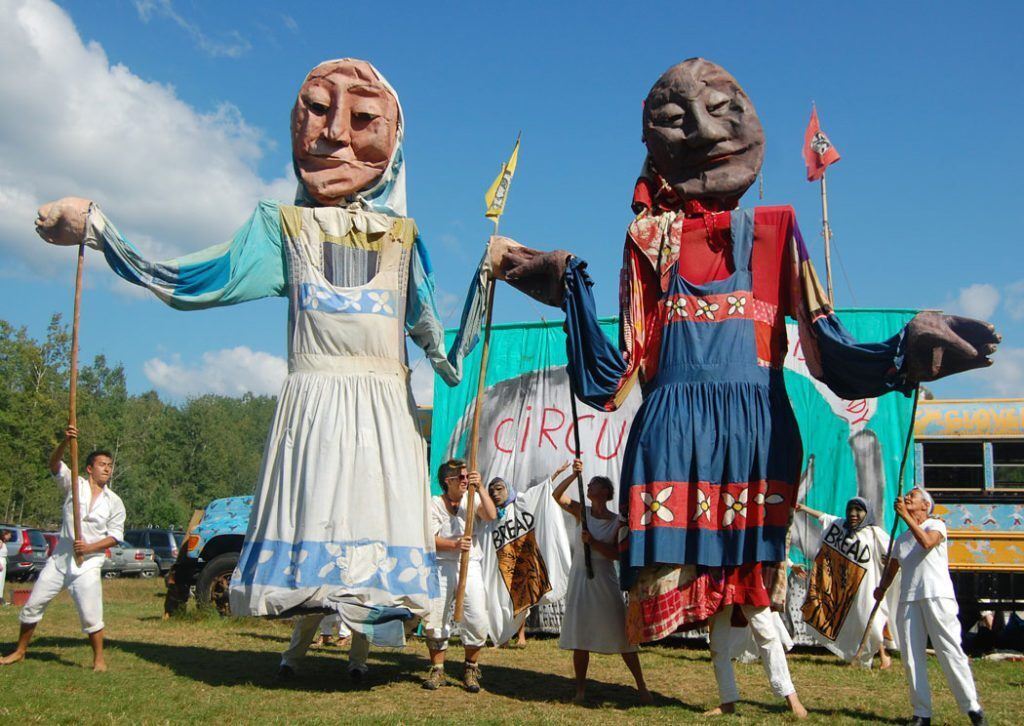
See! They are BIG puppets.
Last night’s show was The Upside Down World Circus. I had pretty low expectations. I believe if you want to experience cool, moving artwork, you’ve got to kiss some frogs. This was not a frog! It was so much better than I expected; I laughed, I cried, I was very very impressed.
General Observations
The puppets are ugly and handmade, but/and they have exactly the degree of polish they should have. If they were MORE polished the show would be worse.
Their whole thing is that it’s protest puppetry theater, and that art should be CHEAP. So it looks like it’s all made from stuff you could dumpster-dive for.
The show is centered around a brass (quintuplet?) + accordion + drum, which sets the whole show to music. They’re rough and loose, give the vibe of a New Orleans Mardi Gras band but with different styles.
The bus is the stage; when they are behind the bus they are ‘backstage’, and there’s a circus metaphor of ‘here’s a bunch of small acts and they’re each different’. Some bits are 30 seconds, some are 4 minutes. The music cues tell us when to be loud and when to applaud, when to be quiet.
Perhaps about 20 people running the whole thing. Lots of costume changes and different roles for everybody besides the band. The band played for 90 minute straight at least.
I really thought it was about the puppets and puppetry, but actually it was a lot of THEATER. Like: their comic timing was so good. Their pacing was great. You can tell there’s some cross-training in dance or clown school happening, but again it all felt like you and your friends could do this kind of skit at camp, if you just really committed.
Most acts used costumes where someone was on stilts, or large oversized puppets held up by poles. This worked great to elevate over the crowd, and adds to the scrappiness of this: you don’t need an auditorium or special location to do this - the audience can just sit on a flat surface and the SHOW gets taller.
The only theater-like setup was a bunch of lights; they arranged their own footlights and a couple of downlights on poles, and it worked great.
All the puppets have a very specific visual look, which I’ve seen in their stuff since the 70s. I really wonder about how the show development goes: you’ve got a ragtag bunch of artist-puppet-performers here, how do you enforce the Artistic Direction so consistently? How do you keep out the jugglers?
The older I get (and the more I teach young designers) the more I think the principles of theater are applicable to the profession. I find this difficult to swallow, given my low-key disdain for theater kids, but this is a good example: leaning into the bit helps this work. You’re making big puppets? Make them BIG puppets. How big can they get? This is the design principle I’m harping on all the time: sometimes the thing you need is just MORE MORE MORE MORE MORE.
It sure made me want to try making some stuff like it!
